When preparing the story New Records in Two Events During 2019 last November I never imagined that a third record would be broken before year end.
But on 8 December, less than one month later, Tonya Nero set a new marathon record of 2h42:58 in Sacramento, California, breaking the 2h43:14 national record she did at the 2012 Rotterdam marathon.
The first national marathon record (4h25:12) was set by Flavia Marin at the 1983 TT marathon, and was improved to 3h53:29 by Cecilia Ferguson in 1984, and to 2h57:18 in 1987 by Deborah Snagg in the USA (Richmond, Virginia).
That mark lasted 25 years until the 2012 clocking by Tonya Nero.
To date only Snagg and Nero have run under 3 hours, while three others have done under 3h10:
3h01:23 Morvine Parris, 1996
3h05:00 Cyrelene Nero, 2000
3h06:55 Sjaelen Evans, 2018
(Parris is a Guyanese born athlete who naturalized in 1995, and Cyrelene is the mother of Tonya).
Tonya Nero is currently our best distance runner, but she is not a marathon specialist. Nevertheless, in each of the last four years she has run the distance under 3 hours.
2016 Dubai 2h59:47
2017 Trinidad 2h56:33
2018 Dubai 2h47:19, Commonwealth Games 2h55:14, Toronto 2h54:55
2019 Sacramento 2h42:58
Her next run over the marathon distance is eagerly awaited.
As President, I take this opportunity to thank you, the public for your patience during these unusual times that we are experiencing along with the rest of the world. I also extend my appreciation for your continued commitment and dedication to ensure that your fitness levels remain at competition standard as the levels of creativity that have been adapted by both coaches and athletes have been commendable whilst still maintaining the regulations implemented by the Government of the Republic of Trinidad and Tobago (GORTT).
As you may recall, I would have sent a letter to all Member Clubs on May 12, 2020 outlining the current situation surrounding the pandemic that has impacted our sport worldwide. The Association continues to monitor the situation as the Government reopens the country on a phased basis on the advice of the medical experts.
I trust that you and your families are keeping well and safe in these unprecendented times. As President, I want to take this opportunity to update you on the latest developments of Government as it relates to our sport, as they continue to implement measures to keep the citizens of Trinidad and Tobago safe during this worldwide pandemic.
The two new national records of 2019 came in the men`s long jump and shot put.
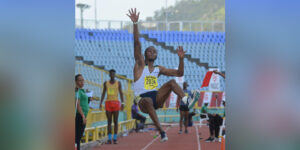
In the long jump Andwuelle Wright jumped 8.25m on 15 July when taking the NACAC under 23 title in Queretaro, Mexico, adding 2 cm to the old record he had set in 2018.
Actually, in that competition Wright did 8.25m twice: in the third round (with 0.7 wind) and in the sixth round (with 1.3 wind).
The shot put record was broken by Akeem Stewart when he threw 20.43m on 16 March while winning a competition at Coral Gables, Florida. The previous mark of 19.96m had been established by Stewart himself in 2016.
In summary both new records were set abroad by athletes who held the old records.No women`s records were broken, nor were any Junior under 20 ones during the year. Perhaps Olympic year 2020 might see our athletes breaking more than two records.
Akeem Stewart set a national shot put record of 20.43m in March 2019, the first TT athlete over 20 metres in this event. Back in 1906 LC Pouchet had set the record at 10.05m (33 feet), less then half the distance reached by Stewart.
Since then many athletes have held the record in the only throwing event on the TT athletics programme before the discus and javelin were introduced in the 1940s.
Bert Harragin did 11.40 (37-5) in 1908 and John Ashmead reached 13.03 (42-9) in 1945. In the fifties Conrad Derrick dominated the event locally and brought the record to 13.35 (43-9 ¾) in 1959.
Roy Hollingsworth, who had studied in England and represented Great Britain in the discus throw at the 1964 Olympics, returned home the following year and in 1967 set the shot record at 15.71m. This mark lasted until Hubert Maingot improved it several times over a decade to 17.68 in 1985.
In 1987 James Dedier brought the record to 17.86, which lasted until 2000 when Dave Stoute attained 18.91m. Then Akeem Stewart arrived on record scene with 19.34 in 2013, 19.96 in 2016 and 20.43 in 2019.
In a world perspective, it should be pointed out that over 320 athletes have thrown further than 20.43m. Of these 153 over 21 metres, 27 over 22 metres and just 2 (American Randy Barnes 23.12 in 1990 and East German Ulf Timmermann 23.06 in 1988) over 23 metres.
One last curiosity, no less than six of the top ten shot putters on the current world all time list achieved their best in 1990 or before.
The national women`s 4x100m relay record over the last half century has made uneven progress.
Between 1960 (when Trinidad-Tobago won the British West Indies Championships gold medal in 50.4) and 1982 (when our team won the CAC Games gold medal in 44.86) the record improved by over 5 seconds.
It then took another two decades (1982-2003) before the record went under 44, as our team clocked 43.97 on finishing fourth at the 2003 Pan American Games.
Over the next ten years the record slowly edged to 43.89 (2004), 43.43 (2008), 43.22 (2009) and 43.01 (2013).
(Unfortunately, times of 42.50 at the Daegu 2011 World Championships and 42.31 in the 2012 London Olympics semi-final were disallowed because of a doping violation by one of the four athletes).
The first official time under 43 seconds came at the 2014 World Relay Championships when our team recorded 42.59 seconds.
This was bettered twice at the 2015 Beijing World Championships when we ran 42.24 in the semi-final, and then 42.03 to take the bronze medal in the final. Team members in that final were Kelly Ann Baptiste, Michelle-Lee Ahye, Reyare Thomas and Semoy Hackett (in place of Khalifa St Fort who had anchored the semi- final).
It is interesting to note that Jamaica, Russia, Germany, Great Britain, France and Bahamas have run under 42 seconds and that the USA has done under 41 seconds (with the world record 40.82 set at the London Olympics).
We now look forward to Trinidad-Tobago joining the seven countries already in the under 42 club.
In the 85 years since Mannie Dookie represented Trinidad-Tobago at the 1934 Empire (now Commonwealth) Games, our athletes have competed and won over 65 medals at these Games, the Olympics, the World Championships (outdoors and indoors) and the Pan American Games.
Gold medals were won by nine athletes individually and by four men`s relay teams: 4x100m at 2008 Olympics, 4x440y at 1966 Commonwealth Games, and 4x400m at 2015 Pan American Games and 2017 World Championships.
Ato Boldon (200m at 1997 World Championships and 100m at 1998 Commonwealth Games) and Keshorn Walcott (javelin at 2012 Olympics and 2014 CG) are to date the only athletes with two individual golds.
The seven other gold medallists are Hasely Crawford (100m at 1976 Olympics), Jehue Gordon (400m hurdles at 2013 World Championships), Cleopatra Borel (shot put at 2015 Pan American Games) and CG champions Mike Agostini (100y 1954), Wendell Mottley (440y 1966), Michelle-Lee Ahye (100m 2018) and Jereem Richards (200m 2018).
Borel, with six medals between 2006 and 2015, is our leading female athlete at the global and hemispheric events under consideration.
Among the men six athletes, all sprinters, have won six or more medals: Edwin Roberts and Boldon with nine each, Marc Burns with eight, Agostini and Lalonde Gordon with seven each, and Jarrin Solomon with six.
Interestingly, Solomon won all six medals in relay races, Burns seven medals in relay races (his eighth the 100m bronze at 2006 CG), and Lalonde Gordon five relay medals (plus 400m bronze at 2012 Olympics and 2014 CG).
For various reasons the list of female athletes is not as impressive. Behind Borel and her six medals there are just three ladies with two medals each: horizontal jumper Ayanna Alexander and sprinters Kelly Anne Baptiste and Michelle-Lee Ahye.
Hopefully, in the coming years this gender gap will be closed.
National Association of Athletics Administrations of Trinidad and Tobago hosts athletic track and field meets, posts athletic heats and events results, athlete records and rankings. NAAATT organises championship race fixtures, gold, silver and bronze award ceremonies, coaching and certification resources for athletes and sports clubs in Trinidad and Tobago. Affiliated to: North America, Central America & Caribbean Athletic Association (NACAC), World Athletics (formerly International Association of Athletics Federations IAAF), Trinidad & Tobago Olympic Committee (TTOC).
Copyright © 2025